IT Consulting

IT Consulting & Digital Strategy

Most small and medium-sized businesses do not have a technology problem. They have a clarity problem. We help your business identify exactly what is not working in your digital setup, before you invest in the wrong direction.
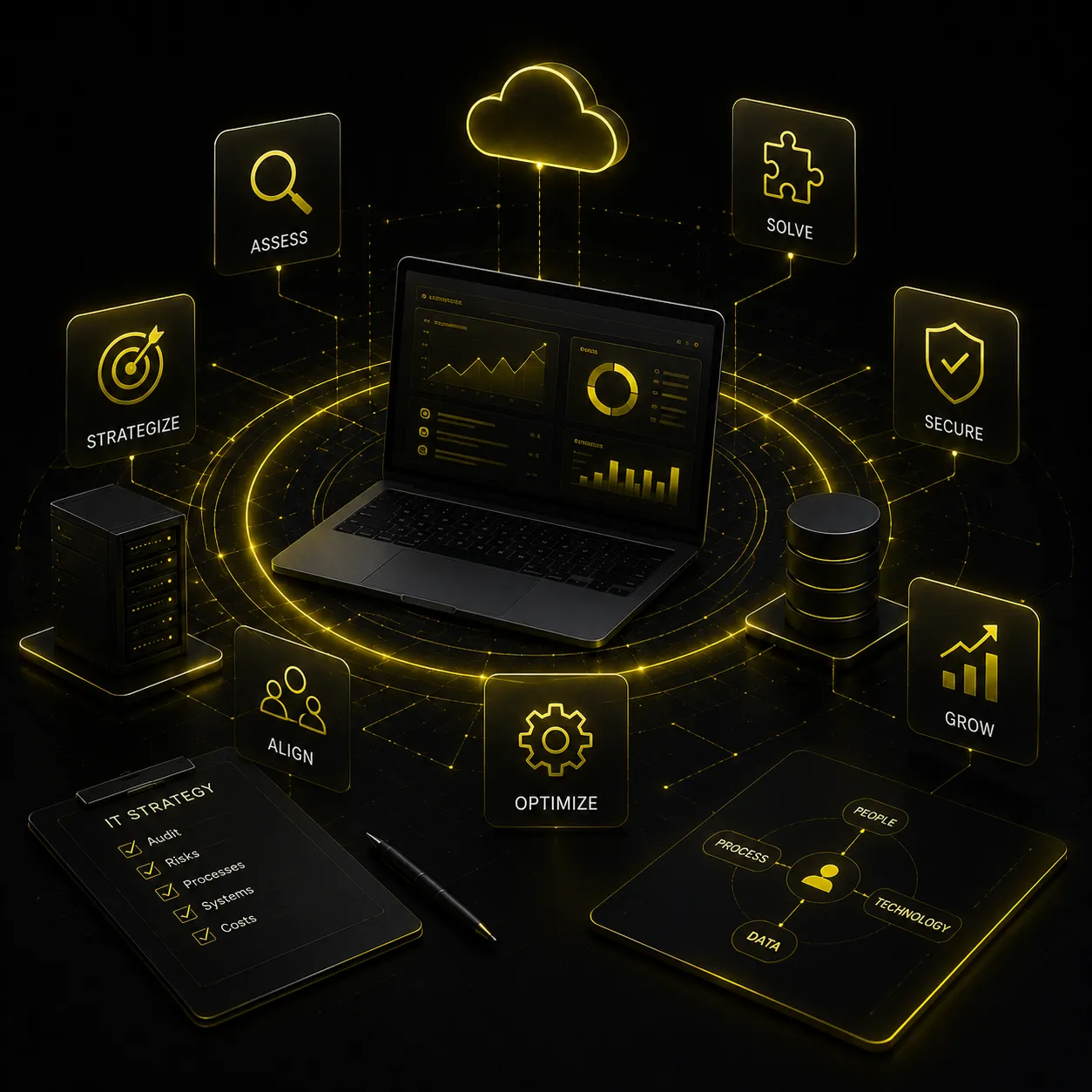
Futuristic IT consulting dashboard with digital audit, strategy, security, optimization, and growth connected into a coherent technology system.
The problem

The wrong technology makes your business harder to run.

There comes a point when a business grows enough that the way it operates internally no longer keeps up with what is happening externally. Usually, it is a slow build-up of improvised fixes that may have worked one by one, but no longer work together.

The most common issues we encounter:

You choose solutions before defining the problem

Many technical decisions are made too early: you choose a CRM, a platform, or start development before your processes, priorities, and business objectives are clearly defined. That is how businesses end up investing in solutions that look good on paper, but do not solve the right problems in practice.

Your systems do not communicate with each other

Your website, invoicing, CRM, stock management, or other tools operate separately, without a clear shared logic. Information gets moved manually from one place to another, errors appear, time is lost, and processes become harder to control as the business grows.

You know something needs to change, but you don't know what

You can feel that something is not working - that time is being lost, that things are slipping out of control, that your team is overloaded with tasks that should be running on their own. You know the answer is somewhere in the area of technology or processes, but you don't know whether you need a new website, a CRM, an automation tool, or something entirely different.

You become dependent on systems that are hard to manage

When your infrastructure is built without clarity and without documentation, every change becomes complicated. You end up depending on a single provider, on technical improvisations, or on systems your team does not understand well enough to use efficiently and independently.

Our solution

First, we understand. Only then do we recommend.

The first step is not proposing a platform, an integration, or a custom solution. The first step is understanding how your business actually works in practice - not how it should work on paper, but what is really happening: who does what, how information moves, where time gets lost, and where the errors that cost real money begin to appear.

That means analysing what you already have - your systems, tools, and processes - and identifying what is working, what is holding you back, and what has simply remained there out of inertia. Many business owners discover at this stage that the problem is not a lack of technology, but that the technology they already have is either not being used properly or is not connected to the rest of their systems.

Our approach
At GMG, we believe good technology does not mean more systems. It means systems that make sense together and clearly support the way your business actually works.

Based on that analysis, we come back with concrete, prioritised recommendations: what you can solve immediately with what you already have, what is worth changing and in what order, where an existing platform is enough, and where a custom solution actually makes sense. We do not recommend complexity for its own sake, and we do not push your business toward solutions that are bigger than what it needs at its current stage.

In the end, you do not get a 50-page document that no one reads. You get a clear direction, concrete next steps, priorities, and documentation you can actually use moving forward. The goal is to help you make the right decisions - informed, sustainable ones - without tying up time and budget in the wrong solutions.

What you get

Complete IT consulting. From diagnosis to an actionable roadmap.

Every IT consulting project delivered by GMG includes a real analysis of your business - not a generic list of observations, but an actionable diagnosis, with concrete recommendations and a direction you can move forward with from the very next day.

IT Audit & Infrastructure Analysis

We start by evaluating what you already have on the technical side: systems, platforms, tools, integrations, and the dependencies between them. We look at where limitations, overlaps, or solutions that no longer properly support your business begin to appear.

Process & Operational Flow Analysis

We analyse how work actually gets done inside your business - not how it is written in job descriptions, but what happens in reality. Where time is lost, where someone has to step in manually, and where information disappears between teams or systems. This map becomes the basis for any correct recommendation.

Platform Recommendations & Digital Architecture

We come back with recommendations tailored to the stage your business is currently in: which CRM, ERP, invoicing platform, or other solutions actually make sense in practice. Not a list of what is most popular on the market - but what fits your business, your real budget, and the way you actually work.

Systems Integration & Process Automation

We identify where systems should communicate with each other and where it makes sense to automate processes that waste time and resources unnecessarily. The goal is not to add more tools, but to create a simpler, more coherent structure that is easier to manage.

Prioritised Technical Roadmap

At the end, you are not left with a generic list of observations. You get a concrete direction: what needs to be done, in what order, what matters most, and where it makes sense to invest first. That allows you to make technical decisions without chaos and without wasting budget on the wrong solutions.

Complete Documentation & Technical Independence

Everything we recommend is clearly documented, so you can move forward either with us or with any other team. We do not create artificial dependencies and we do not leave behind vague conclusions, but a clear foundation your business can use to make informed decisions and implement them properly.

Ready to start? Let's talk about your project.

Request a quote
Frequently asked questions

Everything you need to know about IT consulting and digitalisation.

We answer the most common questions about our process, audits, deliverables, systems, integrations, and the way we help businesses make better technical decisions. If you cannot find what you are looking for here, we are just a message away.

IT consulting for an SME means understanding what is not working in the way your business uses technology, before you invest in platforms, solutions, or development that do not solve the real problem. Its role is not to sell you software, but to give you clarity: what you actually need, what no longer makes sense, what should be changed, and in what order. For a small or medium-sized business, one wrong technical decision costs not just money, but also time and energy from an already limited budget.
It makes sense to use IT consulting when you know something is not working well, but it is not yet clear what should be changed. That may mean slow processes, systems that do not communicate with each other, too much manual work, an upcoming migration, or an important technical investment you do not want to get wrong. IT consulting is especially useful before implementation, not after the costs appear. It helps you choose the right direction, avoid the wrong solutions, and reduce the risk of investing in something that does not genuinely support the way your business works.
IT consulting defines what should be done. Software development builds the solution itself. In other words, consulting clarifies the problem, defines the need, and recommends the right direction, while development comes afterwards as the implementation stage. The difference matters because many businesses go straight into development without first clarifying their processes, priorities, and the right architecture. That often leads to higher costs, changes during implementation, and solutions that only partially solve the real problem.
Yes, IT consulting is highly suitable for small and medium-sized businesses. In many cases, this is exactly where the impact is greatest, because resources are more limited, processes are still taking shape, and one wrong technical decision can quickly waste time, money, and energy. For a small or medium-sized business, IT consulting helps you make better decisions about what is worth implementing, what should be simplified, and which systems make sense for the stage you are in. The goal is not to complicate things with enterprise-level solutions, but to build a digital infrastructure that is clear, efficient, and sustainable for the reality of your business.
Yes, IT consulting still makes sense even if you do not want to build something new from scratch. It can be useful when you want to better understand the systems you already have, choose between different platforms, improve existing processes, or clarify a migration, integration, or technical reorganisation. Not every technical project starts with custom development. Very often, the best decision is to keep what already works, connect your existing systems more effectively, and remove the real bottlenecks before adding new technology.
The process starts with an analysis phase in which we understand your business, your objectives, how your current processes work, and where the real bottlenecks are. Based on that context, we evaluate your existing systems and tools, the way they communicate with each other, and the role technology should actually play in supporting your business. After that stage, we structure the findings and come back with concrete recommendations: what is worth keeping, what needs to change, what can be simplified, and where integration, automation, or technical reorganisation is needed. In the end, you receive a clear direction, priorities, and practical implementation steps - not just general observations.
In an IT audit, we analyse the infrastructure and systems you already use, the way they communicate with each other, and how they support or complicate your day-to-day operations. We look at platforms, tools, integrations, dependencies, limitations, overlaps, and the areas where manual processes, bottlenecks, or wasted time appear. The audit does not stop at the technical layer. We also analyse how information moves through your business, where friction appears between teams, which processes feel heavy, and which solutions no longer match the stage your business is in.
We need as clear a picture as possible of how your business actually works in practice: your key processes, operational flows, which systems and platforms you use, how information moves between them, and where bottlenecks, delays, or manual intervention appear. It also helps a lot to know what you feel is not properly covered right now: where time is being lost, what feels difficult to use, what is too complex for your team. The better we understand the reality of your business, the more practical and better calibrated our recommendations will be.
The timeline depends on the complexity of the project. A simpler audit or analysis can take around one week, while a more complex project - with multiple systems, workflows, teams, and areas that need to be understood in depth - can take up to 8 weeks. The actual timeframe is set based on how extensive the infrastructure is, how many processes need to be analysed, and how clearly the objective is defined from the start.
At the beginning, your involvement is important. We need to understand the real needs of your business, how the processes work in practice, and where you feel the biggest problems are. Without that context, any technical analysis risks remaining incomplete. After the initial stage, your involvement is usually limited to specific clarifications, feedback, and validating the direction. You do not need to be constantly present, but it is essential to be available in the early phase.
At the end, you receive concrete recommendations, a clear technical direction, and implementation steps tailored to your business. You are not left with a generic conclusion, but with a practical foundation for what should be kept, changed, integrated, or built next. Depending on the project, this can include an analysis of your existing infrastructure, conclusions about the processes that are holding you back, recommendations for platforms and systems, implementation priorities, and a clear technical roadmap.
Yes. Our recommendations are meant to be applied, not just read. We tell you what makes sense to do, in what order, what matters most, and where it makes sense to invest first. Our goal is for the outcome to be useful in practice: you should be able to move forward with a clear direction, not with a list of problems that lacks context and prioritisation.
Yes. Everything we recommend is clearly documented, so you can continue using the conclusions even after the collaboration ends. The documentation should help you understand what needs to be done and why, not remain dependent on verbal explanations or on the person who carried out the analysis. Depending on the project, the documentation can include technical conclusions, architecture recommendations, the structure of the processes analysed, implementation priorities, and next steps.
Yes. You can implement the recommendations with us or with any other team you choose. IT consulting should give you clarity and freedom of decision, not lock you into a forced relationship with a single provider. That is exactly why we put so much emphasis on clear documentation and recommendations that can be picked up by someone else.
You do. Access to the accounts, your business data, and the resulting documents should remain yours. We work with what you provide for analysis, but we do not create artificial dependencies and we do not keep control over things that belong to your business. The principle is the same as in the rest of GMG's services: by the end, you should have clarity, access, and control.
We choose the right system based on the real needs of your business, not on what happens to be popular in the market. We look at your processes, workload, objectives, the team that will actually use it, and how well it needs to integrate with what you already have. A good system is not the most complex one, but the one that solves the problem properly for the stage your business is in.
A custom solution makes sense when your needs are not properly covered by existing platforms or when your processes are specific enough that a standard solution would create too many limitations. An existing platform is enough when it covers what you need well, without making implementation and maintenance unnecessarily complicated. Custom development is worth it when it brings real control, flexibility, and scalability - not just extra complexity.
Yes. We can recommend the right integrations between the systems you already use or plan to implement. The goal is for information to move more coherently, manual work to be reduced, and there to be fewer disconnects between operations, sales, invoicing, and the other areas of your business. We do not propose integrations just because they sound good, but only where they create real simplification.
Yes. This is one of the situations where IT consulting is most useful. When you have multiple disconnected systems, duplicated work, errors, delays, and hard-to-track processes appear very quickly. In these cases, we analyse how information moves between systems, where the disconnects appear, and what can be connected, simplified, or reorganised.
Yes. We can help plan a migration so that the transition is as controlled as possible and the risk of losing data, functionality, or operational continuity is reduced. Before migration, we analyse the existing structure, dependencies, important data, and the functionality that needs to be protected. The goal is for the new solution to carry over what truly matters, without bringing the old problems into the new system as well.
Let's build something together

Have a project in mind? Let's talk!

If you have questions or need a custom quote, do not hesitate to contact us.

Response within 24h No hidden costs You own 100% of the copyright Clear contract from the start